
Queen at Sea | 2026

O sexo ocupa uma parcela crucial na vida de cada indivíduo. Instinto corporal, impulso orgânico, meio de reprodução, manifestação de desejos ou consequência de sentimentos, a relação sexual permeia de forma saudável a nossa existência desde a puberdade e o adolescer – quando o corpo passa por transformações, começamos a explorá-lo e fatores sociais e biológicos passam a instigar nossa curiosidade, despertando a atração por outras pessoas – até o fim de nossas vidas, pois sim, pessoas idosas transam, ainda que seja inacreditavelmente um tabu social lidar com esse fato.
É certo que o sexo e a sexualidade, por serem inerentes à condição humana, deveriam ser tratados com a mesma naturalidade e importância com que integram nossas vivências e experiências. Entretanto, estamos inseridos em um modelo social patriarcal que os transformou em instrumento de imposição de poder do masculino sobre o feminino. Por essa razão, aquilo que é saudável torna-se sobremaneira nocivo quando o elemento definidor dessa saúde passa a ser violado e extrapolado: o consentimento.
A mesma estrutura que induz, em sua base e construção, a dominação em razão do gênero e o (ab)uso do sexo como mecanismo para tal, vê-se obrigada a criminalizá-la ao reconhecer que se trata de uma forma de violência. Os crimes de estupro, violação sexual mediante fraude e assédio sexual estão previstos no Código Penal Brasileiro, e é provável que não exista sequer um ordenamento jurídico no mundo que não preveja criminalizações semelhantes. A tipificação e a punição, entretanto, não bastam para que suas ocorrências sejam efetivamente reprimidas.
Os motivos para que continuem a ocorrer são muitos e, em sua maioria, estão relacionados à eficácia dessa própria lógica de subjugação: o medo da vítima, as ameaças, a dificuldade de compreensão imediata de que se trata de uma violência, os traumas, os obstáculos probatórios, a morosidade do sistema e a impunidade. No mais, com assombro, assistimos hoje à ampla circulação do discurso redpill, que estimula e alimenta abertamente a misoginia, enquanto as instituições parecem, para nosso desespero, permanecer inertes. Por vezes parece não haver, de fato, solução.
Neste cenário, onde o consentimento e a conscientização sobre seu valor nas relações constituem a chave para a caracterização da violação e do entendimento dos limites, como lidar com sua expressão por aqueles que não são capazes de se comunicar plenamente? Ou ainda, como tratar os impulsos sexuais de quem já não possui lucidez para consentir, mas cujos corpos, instintivamente, continuam a se manifestar sexualmente? Para complicar: quem decide, nesses casos, o que é e o que não é legítima manifestação de vontade? A complexidade do sexo e as fronteiras que delimitam sua existência saudável fazem de Queen at Sea, longa de Lance Hammer exibido na Competição da 76ª Berlinale, um estudo geracional sobre a relação do ser humano com essa prática íntima tão natural entre pessoas, e sobre o quanto ela pode ser, ao mesmo tempo, prazerosa e problemática.
Amanda (Juliette Binoche) cuida de sua mãe, Leslie (Anna Calder-Marshall), que sofre de demência avançada. O dever de cuidado é compartilhado com seu padrasto, Martin (Tom Courtenay), casado com Leslie há quase duas décadas. Um dilema moral surge entre os dois responsáveis depois que Amanda flagra, por diversas vezes, o casal fazendo sexo: na visão da filha, a mãe não possui qualquer condição de consentir com o ato, pois a doença lhe retirou a agência sobre suas vontades; na perspectiva do marido, ele estaria apenas concretizando os desejos da esposa, cujas expressões afirma compreender com clareza. A insistência de Martin leva Amanda a tomar uma decisão que desencadeará uma série de consequências e colocará a situação em patamares ainda mais delicados: ela chama a polícia.
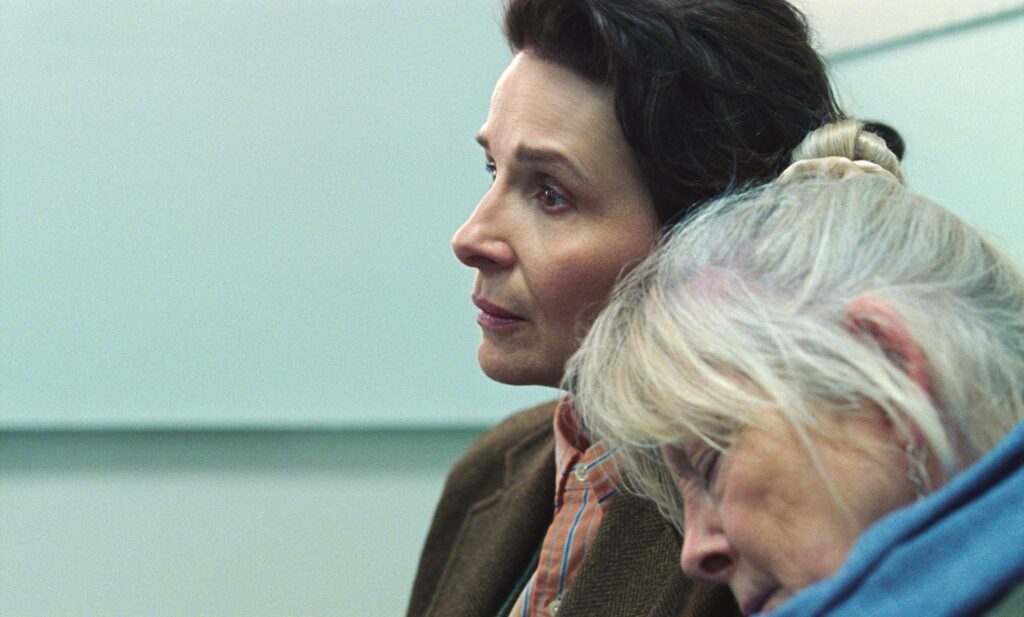
Se, a princípio, concordamos com Amanda – sobretudo considerando que a esmagadora maioria dos estupros ocorre dentro de casa e é cometida por pessoas conhecidas -, o confronto mais próximo com os personagens e com suas dinâmicas faz com que, assim como a protagonista, entremos em um looping de dúvidas, especialmente quanto à tomada de decisões moralmente corretas, mas cujos efeitos revelam que nada é tão simples assim. Acionar a polícia é tratar o ocorrido como crime, e via de consequência, todo procedimento e burocracia que o envolve. É, ainda, punir, e isso significa afastar Martin de Leslie, e portanto, sofrimento.
Nessa percepção mais profunda que gira ao redor de compreender ou não Martin como um criminoso, o trabalho de Anna Calder-Marshall e Tom Courtenay é crucial – não à toa os dois compartilharam a premiação de melhor atuação coadjuvante na Berlinale. Ambos são soberbos na exteriorização sutil das manifestações de afetos e trocas de uma cumplicidade prometida para a vida toda, ao mesmo tempo em que claramente estão perdidos – ela pela doença, ele por de repente não saber mais se está fazendo o melhor para a esposa que ele ama.
Há de se mencionar que é brilhantemente espantosa a capacidade de Calder-Marshall, cuja personagem fala muito pouco por sua condição, de se expressar pelos olhos, trejeitos e gestos. A atriz precisa assumir a instintividade como diretriz das atitudes de Leslie, e o faz por meio de um olhar desorientado e ansioso, que busca validação e conforto, com o caminhar quase infantil e com movimentos que comovem de tão honestos e representativos de seus resquícios de lucidez.
Paralelamente aos impasses morais, médicos e familiares relacionados aos dois idosos, Amanda lida com a filha adolescente, Sara (Florence Hunt), e é aqui que Hammer traça um caminho mais análitico sobre o papel e os dilemas do sexo durante a vida. Ao passo que a avó está no fim da vida e vê-se presa num corpo que deseja biologicamente o sexo, mas é incapaz de consenti-lo de forma plena e confiável, a neta começa a descobrir os prazeres e empolgações da primeira paixão. Muito embora a garota vá desvendando de forma muito positiva as mudanças do corpo, é inevitável não sentir certo temor, uma vez que nossa percepção permanece voltada à possível situação de abuso no outro extremo geracional dessa família. Queen at Sea provoca essa dualidade e sugere sua complexidade e, embora não assuma qualquer definição a respeito, deixa claro que a sociedade ainda carece de debates mais amplos e abertos sobre a sexualidade.
Toda a cadeia de acontecimentos decorre, sobretudo, da responsabilidade de Amanda para com sua mãe. Assim, para além da moralidade, ela assume o encargo de tomar decisões em nome da idosa e também, naquele contexto, de seu padrasto – invadindo, queira ou não, suas privacidades e intimidades. Falar em nome de alguém e representar os interesses de um terceiro, especialmente de um ente querido que já não pode fazê-lo por si, implica viver sob a constante dúvida quanto à melhor escolha e sob o risco permanente de arrependimentos.
O intuito inicial de Amanda não era transformar Martin em um criminoso, mas dar-lhe um susto para que finalmente parasse de transar com a esposa. A decisão de chamar a polícia, portanto, revela-se um ato de desespero cujas proporções não foram devidamente medidas ou ponderadas. Chega a ser tragicômico – e Hammer reforça esse caráter ambíguo – o isolamento da cama do casal como “cena do crime”: não sabemos se rimos ou choramos diante dos peritos vestidos com roupas de proteção, máscaras e luvas, retirando o lençol da cama para colocá-lo em um saco plástico como a suposta prova do crime.
Se nos rendemos ao riso, já que Sara, a neta, ri conosco da confusão que se instaura na casa, o humor logo se converte em inquietação diante do sofrimento de Leslie, não apenas com o afastamento do marido, mas também com toda a série de exames a que precisa ser submetida para a perícia médica – afinal, estamos diante da possibilidade de um crime. Trata-se de uma cena extremamente incômoda, na qual Juliette Binoche transita entre acolher a mãe com carinho e sentir-se culpada pela bola de neve imprevista.
Em Queen at Sea, damos conta de que, em um mundo onde o sexo pode ser usado como arma de dominação, ele pode representar tanto o céu quanto o inferno das relações, sendo motivo tanto para a construção de seu início quanto para a precipitação de seu fim. E quando cabe a alguém determinar os limites dessa prática e decidir sobre o corpo e o desejo de outro, resta apenas a percepção desconcertante de que talvez não exista, de fato, um caminho correto – e de que ninguém sabe exatamente o que fazer diante da complexidade colossal de certas situações.
English Version:
Sex occupies a crucial portion of every individual’s life. A bodily instinct, an organic impulse, a means of reproduction, a manifestation of desires or a consequence of feelings, sexual relations permeate our existence in a healthy way from puberty and adolescence—when the body undergoes transformations, we begin to explore it, and social and biological factors start to instigate our curiosity, awakening attraction toward other people—until the end of our lives, because yes, elderly people have sex, even though it is unbelievably still a social taboo to deal with this fact.
It is certain that sex and sexuality, because they are inherent to the human condition, should be treated with the same naturalness and importance with which they integrate our lives and experiences. However, we are inserted into a patriarchal social model that has transformed them into an instrument for imposing male power over the female. For this reason, what is healthy becomes exceedingly harmful when the defining element of this health is violated and overstepped: consent.
The same structure that induces, at its very foundation and construction, domination on the basis of gender and the (ab)use of sex as a mechanism for such domination, finds itself forced to criminalize it upon recognizing that it constitutes a form of violence. The crimes of rape, sexual violation through fraud, and sexual harassment are provided for in the Brazilian Penal Code, and it is likely that there is not a single legal system in the world that does not provide for similar criminalizations. Typification and punishment, however, are not enough for their occurrences to be effectively suppressed.
The reasons why they continue to occur are many and, for the most part, are related to the effectiveness of this very logic of subjugation: the victim’s fear, threats, the difficulty of immediately understanding that it is a form of violence, the traumas, evidentiary obstacles, the slowness of the system, and impunity. Moreover, with astonishment, we now witness the wide circulation of redpill discourse, which openly stimulates and feeds misogyny, while institutions seem, to our despair, to remain inert. At times it seems that there is, in fact, no solution.
In this scenario, where consent and awareness of its value in relationships constitute the key to characterizing violation and understanding limits, how should we deal with its expression by those who are not capable of communicating fully? Or further still, how should we treat the sexual impulses of those who no longer possess the lucidity to consent, but whose bodies instinctively continue to manifest sexually? To complicate matters: who decides, in these cases, what is and what is not a legitimate manifestation of will? The complexity of sex and the boundaries that delimit its healthy existence make Queen at Sea, a feature film by Lance Hammer shown in the Competition of the 76th Berlinale, a generational study of the human relationship with this intimate practice so natural among people, and of how it can be, at the same time, pleasurable and problematic.
Amanda (Juliette Binoche) takes care of her mother, Leslie (Anna Calder-Marshall), who suffers from advanced dementia. The duty of care is shared with her stepfather, Martin (Tom Courtenay), who has been married to Leslie for almost two decades. A moral dilemma arises between the two caregivers after Amanda catches the couple having sex on several occasions: in the daughter’s view, her mother has no condition whatsoever to consent to the act, since the illness has taken away her agency over her own will; from the husband’s perspective, he is merely fulfilling his wife’s desires, whose expressions he claims to understand clearly. Martin’s insistence leads Amanda to make a decision that will trigger a series of consequences and place the situation on even more delicate ground: she calls the police.
If, at first, we agree with Amanda—especially considering that the overwhelming majority of rapes occur inside the home and are committed by people known to the victim—the closer confrontation with the characters and their dynamics makes us, just like the protagonist, enter a loop of doubts, especially regarding the making of morally correct decisions whose effects reveal that nothing is as simple as it seems. Calling the police is to treat what happened as a crime, and consequently everything that procedure and bureaucracy entails. It is also to punish, and that means separating Martin from Leslie, and therefore causing suffering.
In this deeper perception that revolves around whether or not to understand Martin as a criminal, the work of Anna Calder-Marshall and Tom Courtenay is crucial—not by chance the two shared the award for Best Supporting Performance at the Berlinale. Both are superb in the subtle externalization of manifestations of affection and exchanges of a complicity promised for a lifetime, while at the same time clearly being lost—she because of the illness, he because he suddenly no longer knows whether he is doing what is best for the wife he loves.
It must be mentioned that the capacity of Calder-Marshall—whose character speaks very little due to her condition—to express herself through her eyes, mannerisms, and gestures is astonishingly brilliant. The actress needs to assume instinctiveness as the guiding principle of Leslie’s actions, and she does so through a disoriented and anxious gaze that seeks validation and comfort, with an almost childlike walk and with movements that are moving for how honest they are and how representative they are of her remnants of lucidity.
Parallel to the moral, medical, and family impasses related to the two elderly characters, Amanda deals with her teenage daughter, Sara (Florence Hunt), and it is here that Hammer traces a more analytical path regarding the role and dilemmas of sex throughout life. While the grandmother is at the end of her life and finds herself trapped in a body that biologically desires sex but is incapable of consenting to it in a full and reliable way, the granddaughter begins to discover the pleasures and excitements of her first love. Although the girl discovers the changes in her body in a very positive way, it is inevitable not to feel a certain fear, since our perception remains focused on the possible situation of abuse at the other generational extreme of this family. Queen at Sea provokes this duality and suggests its complexity and, although it does not assume any definitive position on the matter, it makes clear that society still lacks broader and more open debates about sexuality.
The entire chain of events stems, above all, from Amanda’s responsibility toward her mother. Thus, beyond morality, she assumes the burden of making decisions on behalf of the elderly woman and also, in that context, of her stepfather—invading, whether she wishes to or not, their privacy and intimacy. Speaking in someone else’s name and representing the interests of a third party, especially a loved one who can no longer do so for themselves, implies living under the constant doubt regarding the best choice and under the permanent risk of regret.
Amanda’s initial intention was not to turn Martin into a criminal, but to scare him so that he would finally stop having sex with his wife. The decision to call the police, therefore, reveals itself as an act of desperation whose proportions were not properly measured or considered. It is almost tragicomic—and Hammer reinforces this ambiguous character—the isolation of the couple’s bed as a “crime scene”: we do not know whether we laugh or cry when faced with the forensic experts dressed in protective clothing, masks, and gloves, removing the bedsheet from the bed and placing it in a plastic bag as the supposed evidence of the crime.
If we give in to laughter, since Sara, the granddaughter, laughs with us at the confusion that takes over the house, the humor soon turns into unease in the face of Leslie’s suffering, not only because of the separation from her husband, but also because of the entire series of exams she must undergo for the medical examination—after all, we are facing the possibility of a crime. It is an extremely uncomfortable scene, in which Juliette Binoche moves between comforting her mother with affection and feeling guilty for the unforeseen snowball effect.
In Queen at Sea, we realize that in a world where sex can be used as a weapon of domination, it can represent both the heaven and the hell of relationships, serving as a reason both for the construction of their beginning and for the precipitation of their end. And when it falls to someone to determine the limits of this practice and to decide over another person’s body and desire, what remains is the unsettling perception that perhaps there is, in fact, no correct path—and that no one truly knows what to do when faced with the colossal complexity of certain situations.