Whispers in May | 2026
Alguns contos e histórias populares expressam universalidades que dizem muito a respeito do modo de viver das sociedades no decorrer do tempo. Há diversidade de culturas e sociedades, e portanto, diversidade de histórias. Entretanto, como constatado pela psicóloga junguiana Clarissa Pinkola Estés em Mulheres que Correm com os Lobos, embora com diferentes roupagens, a essência das fábulas se repete em diferentes lugares do mundo, indicando que há um elo conector entre culturas explicado, principalmente, pela psicologia. É quase certo que não há lugar no mundo que tenha se livrado dos efeitos do patriarcado e de estruturas de poder que, cada qual a seu modo, oprima e inferiorize mulheres, e muitos contos refletem, justamente, tais jornadas femininas de autoconhecimento e atravessamentos diante desse contexto.
O folclore do povo Nuosu, que vive principalmente na região de Liangshan, no sudoeste da China, carrega uma tradição transmitida oralmente e que é berço do conto Coqotamat. Em Whispers in May, dirigido por Dongnan Chen, documentário observativo vencedor do DOX:Award 2026, principal prêmio do CPH:DOX, possui um papel crucial não só como guia narrativo, mas como reflexo das limitadas perspectivas de futuro para as mulheres da região através de Qihuo, uma adolescente de 14 anos que, após menstruar pela primeira vez, embarca na estrada, à pé, com as amigas Atnyop e Itgop, a caminho de um lugar onde possam concretizar um rito de passagem local bastante tradicional relacionado à menarca: o ritual da troca de saia.
Whispers in May sintetiza as diversas versões do Coqotamat e através da ficcionalização do conto, abre-se para o formato híbrido ao permitir que as meninas simulem essa busca com a naturalidade e a fluidez que só a imaginação e honestidade infantis são capazes de proporcionar. Na releitura fílmica, a história se relaciona a uma mãe que, para salvar seu filho homem, precisa abandonar as filhas mulheres. No percurso, as filhas sendo conduzidas pela mãe pela montanha são enganadas pelos seres que encontram no caminho, cruzam florestas e desafiam monstros. A diretora insere trechos escritos da lenda como pontos de costura narrativa, através de inscrições rupestres em azul fluorescentes que marcam cada virada de capítulo.
Qihuo, Atnyop e Itgop vivem no vilarejo remoto das montanhas Liangshan, na China. Nessa zona totalmente rural, a maior parte dos adultos deixa o interior para trabalhar nas fábricas mais próximas e prover o sustento familiar, e para tanto, deixam os filhos sob os cuidados dos avós ou outros parentes que ficam. Não é outra a situação das meninas, e ainda mais delicada, a da protagonista Qihuo, responsável por ajudar a prima a cuidar dos irmãos mais novos, vivendo sozinha na casa da avó que faleceu há pouco tempo. O estado é de latente abandono. A casa está suja, a menina precisa preparar suas próprias refeições e não há comida. Exige-se que vá para a escola, já que as possibilidades da vida adulta ali são apenas duas: ir para as fábricas como os pais ou buscar nos estudos uma vida diferente. Em qualquer das alternativas, casar e ter filhos parece ser uma imposição.
Dongnan Chen encontra na contemplação, no silêncio, na força das imagens, e principalmente, na simplicidade pueril, o tom reflexivo de Whispers in May, que recusa a ferramenta da narração ou os diálogos como vetores. São as experiências, as expressões e a relação das meninas com o meio os mecanismos que revelam ao mundo o olhar dessas crianças diante da precariedade, e outrossim, buscam evidenciar para as próprias crianças suas importâncias num mundo que parece invisibilizar suas existências.
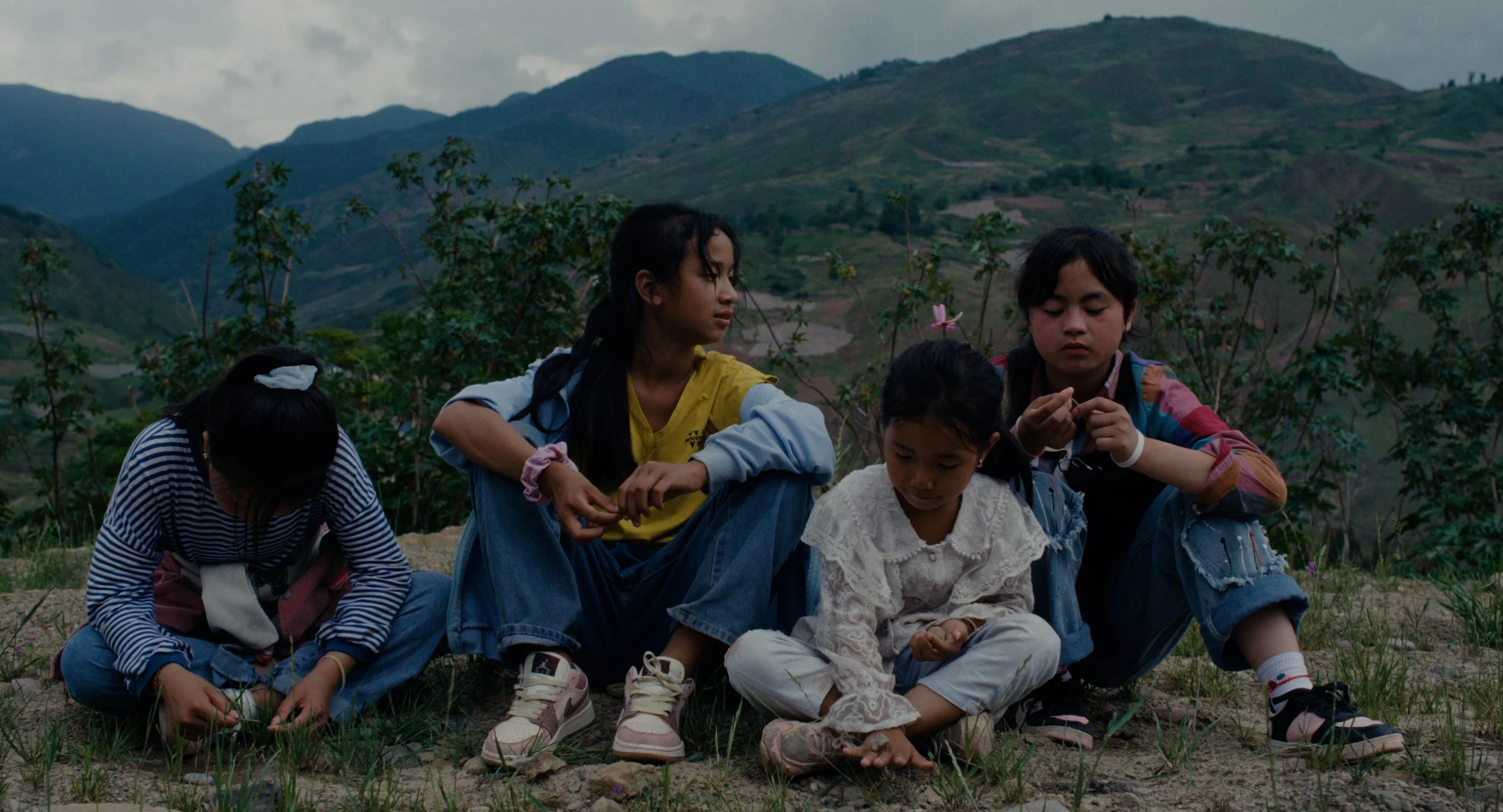
Enquanto caminham, as vemos pequenas diante da vastidão das montanhas de Liangshan. Assistimos um amadurecimento forçado e melancólico, pois a chegada da menstruação, naquele meio social, não significa apenas o crescimento, mas a possibilidade da mulher trabalhar, casar-se e conceber, ao que claramente elas não estão preparadas. A falta de esperança no olhar de Qihuo, quando não está rindo com as amigas e sendo a criança que é, é de cortar o coração.
A falta de horizontes naquele contexto espacial e cultural e o intermédio do olhar feminino infantil como ponto de reflexão aproxima Whispers in May do doce A Fabulosa Máquina do Tempo, da diretora brasileira Eliza Capai. No entanto, em sendo realidades muito distintas, enquanto em Guaribas – PI, há um programa social que visa a concessão de bolsas às famílias em prol de uma vida digna, e consequentemente, proporcionar novas perspectivas de vida às gerações seguintes, em Liangshan a sensação de desesperança prevalece, pois o destino das meninas parece traçado desde o berço.
A jornada em busca de uma saia para o rito de passagem da menarca lembra um tanto O Bolo do Presidente, de Hasan Hadi: em ambos, crianças se veem sozinhas, em estados de abandono, guiando-se por si próprias para fazer aquilo que os adultos não fazem por elas. A ficcionalização parcial de Whispers in May facilita a compreensão da realidade e proporciona experiências genuínas entre as meninas, e há muita beleza na composição entre o material humano e a beleza natural ali presentes na câmera pouco interventiva de Dongnan Chen. Entretanto, o conto faz lembrar que a realidade nunca deixou de espreitar e reproduzir um sistema patriarcal exploratório, onde crianças adquirem frieza e endurecimento suficiente para afirmarem que ninguém se importaria se elas não voltassem mais e que não há futuro melhor para elas – nesse sentido, é expressivo o desaparecimento delas em meio a neblina da montanha.
English Review:
Some tales and popular stories express universalities that say a great deal about the ways societies have lived over time. There is a diversity of cultures and societies, and therefore, a diversity of stories. However, as noted by Jungian psychologist Clarissa Pinkola Estés in Women Who Run with the Wolves, although in different forms, the essence of fables repeats itself in different parts of the world, indicating that there is a connecting link between cultures explained mainly by psychology. It is almost certain that there is no place in the world that has escaped the effects of patriarchy and power structures that, each in their own way, oppress and diminish women, and many tales reflect precisely these female journeys of self-discovery and endurance within this context.
The folklore of the Nuosu people, who live mainly in the Liangshan region in southwestern China, carries a tradition passed down orally and is the birthplace of the tale Coqotamat. In Whispers in May, directed by Dongnan Chen, an observational documentary winner of the DOX:Award 2026, the main prize at CPH:DOX, this tale plays a crucial role not only as a narrative guide but also as a reflection of the limited future prospects for women in the region through Qihuo, a 14-year-old girl who, after menstruating for the first time, sets off on foot with her friends Atnyop and Itgop toward a place where they can carry out a very traditional local rite of passage related to menarche: the skirt-changing ritual.
Whispers in May synthesizes the various versions of Coqotamat and, through the fictionalization of the tale, opens itself to a hybrid format by allowing the girls to simulate this journey with the naturalness and fluidity that only childlike imagination and honesty can provide. In the filmic reinterpretation, the story relates to a mother who, in order to save her son, must abandon her daughters. Along the way, as the daughters are led through the mountains by their mother, they are deceived by beings they encounter, cross forests, and face monsters. The director inserts written excerpts of the legend as narrative stitching points, through fluorescent blue rock inscriptions that mark each chapter transition.
Qihuo, Atnyop, and Itgop live in a remote village in the Liangshan mountains, in China. In this entirely rural area, most adults leave the countryside to work in nearby factories to provide for their families, leaving their children in the care of grandparents or other relatives who remain behind. The girls are no exception, and the situation is even more delicate for the protagonist Qihuo, who is responsible for helping her cousin care for younger siblings, living alone in the house of her grandmother who passed away recently. The condition is one of latent abandonment. The house is dirty, the girl must prepare her own meals, and there is no food. She is expected to attend school, since the possibilities for adult life there are only two: go to the factories like their parents or seek a different life through education. In either case, marriage and having children seem to be imposed.
Dongnan Chen finds in contemplation, silence, the strength of images, and especially in childlike simplicity, the reflective tone of Whispers in May, which refuses narration or dialogue as guiding tools. It is the girls’ experiences, expressions, and relationship with their environment that reveal to the world the perspective of these children in the face of precarity, and at the same time seek to show the children themselves their importance in a world that seems to render their existence invisible.
As they walk, we see them as small figures against the vastness of the Liangshan mountains. We witness a forced and melancholic coming of age, as the onset of menstruation, in that social context, signifies not only growth but also the possibility of a woman working, marrying, and bearing children—something they are clearly not prepared for. The lack of hope in Qihuo’s gaze, when she is not laughing with her friends and being the child she is, is heartbreaking.
The lack of horizons in that spatial and cultural context, and the mediation of a young female perspective as a point of reflection, brings Whispers in May close to the gentle The Fabulous Machine of Time, by Brazilian director Eliza Capai. However, given the very different realities, while in Guaribas – PI there is a social program that provides financial aid to families in pursuit of a dignified life and, consequently, offers new perspectives for future generations, in Liangshan the feeling of hopelessness prevails, as the girls’ fate seems determined from birth.
The journey in search of a skirt for the menarche rite of passage somewhat recalls The President’s Cake, by Hasan Hadi: in both, children find themselves alone, in states of abandonment, guiding themselves to do what adults fail to do for them. The partial fictionalization of Whispers in May facilitates the understanding of reality and provides genuine experiences among the girls, and there is great beauty in the composition between the human element and the natural beauty captured by Dongnan Chen’s minimally intrusive camera. However, the tale reminds us that reality has never ceased to lurk and reproduce an exploitative patriarchal system, in which children acquire enough hardness to state that no one would care if they never returned and that there is no better future for them—in this sense, their disappearance into the mountain fog is striking.
Rating: 3.5